There’s no such thing as a typical Hamilton attic.
A brick two-and-a-half storey in Kirkendall from 1912 has almost nothing in common with a 2015 build in upper Stoney Creek. They need different work, they carry different risks, and most attic-insulation advice ignores the difference entirely by pretending every house is the same.
So this splits by what you actually own. Find your house below.
First, the one thing every Hamilton home shares
Whatever the age, the number you care about is the measured depth in your attic today — not the year the house was built, not a builder’s spec sheet, not a guess.
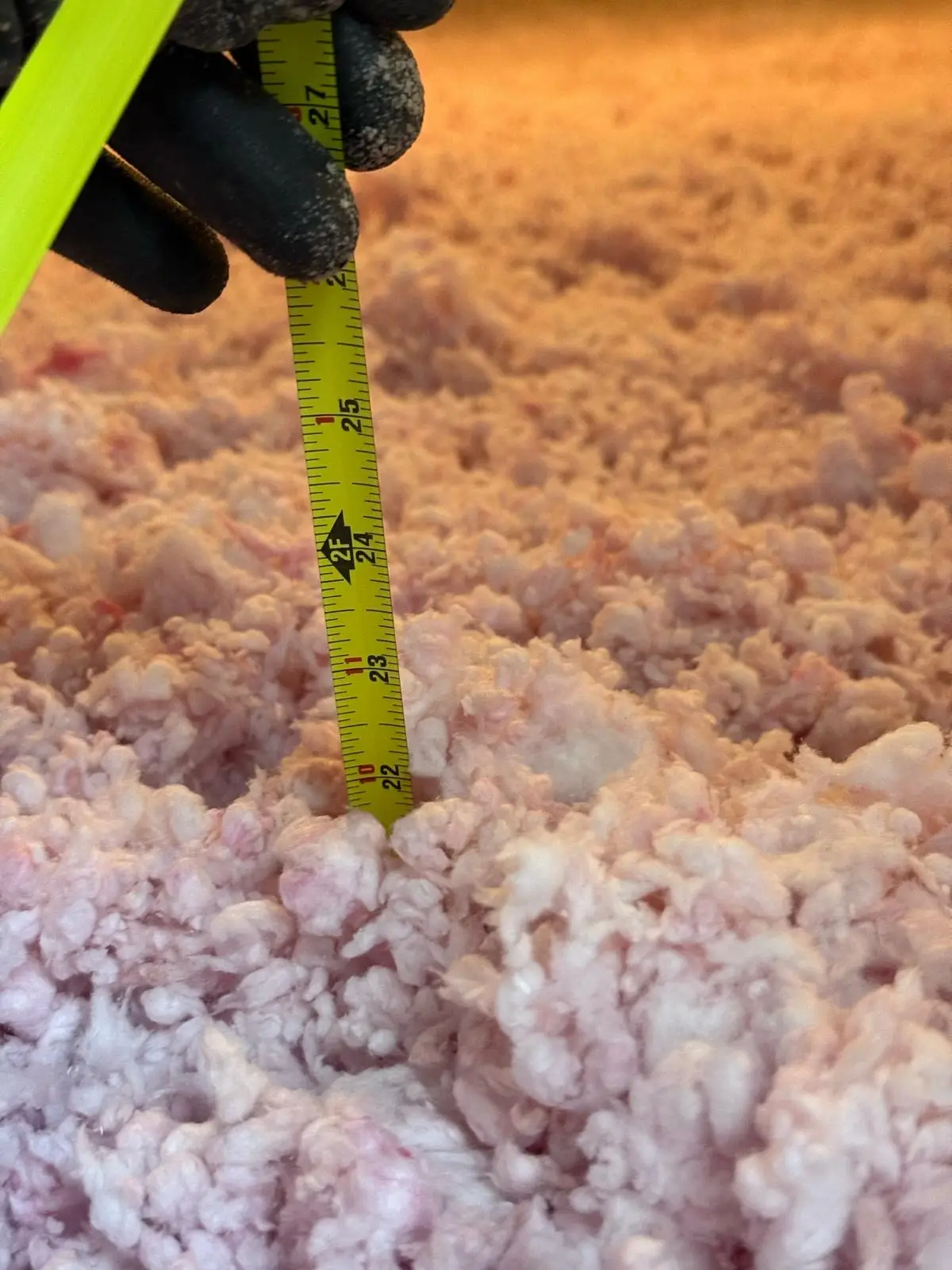
Check it in five minutes:
- Open the hatch, shine a light, step only on the joists — never the insulation
- Push a ruler down to the drywall at several spots, including near the eaves
- Convert:
| Material | R per inch | 8 in | 12 in | 16 in |
|---|---|---|---|---|
| Blown cellulose | ~3.4 – 3.8 | ~R-28 | ~R-42 | ~R-56 |
| Blown fibreglass | ~2.7 – 3.0 | ~R-22 | ~R-34 | ~R-45 |
| Old settled batts | ~2.5 – 3.2 | ~R-22 | — | — |
Target: R-50 minimum to protect rebate eligibility, R-60 where there’s headroom.
Now to what’s specific to your house.
If you own a pre-1950 home (lower city, core, Durand, Kirkendall, Crown Point)
Hamilton’s older neighbourhoods have some of the most characterful housing in Ontario — and some of the trickiest attics.
Knob-and-tube wiring. The pre-1950 wiring system with ceramic knobs and tubes. It sheds heat by having air circulate around the conductors, so burying it in insulation is a safety problem and is generally restricted.
If we find it, work stops until a licensed electrician assesses whether the circuits are live. Live circuits get remediated first; insulation follows. There’s an insurance angle too — many insurers ask about active knob-and-tube, and some won’t write or renew a policy while it’s in service. Going into the attic is a natural moment to find out what you have.
Vermiculite. Loose, pebble-like, greyish-brown granules, sometimes with a slight sheen. It appears in homes insulated mid-century. Vermiculite may contain asbestos and cannot be identified by eye. Don’t disturb it — close the hatch and have it tested. If positive, removal is licensed abatement, not insulation work.
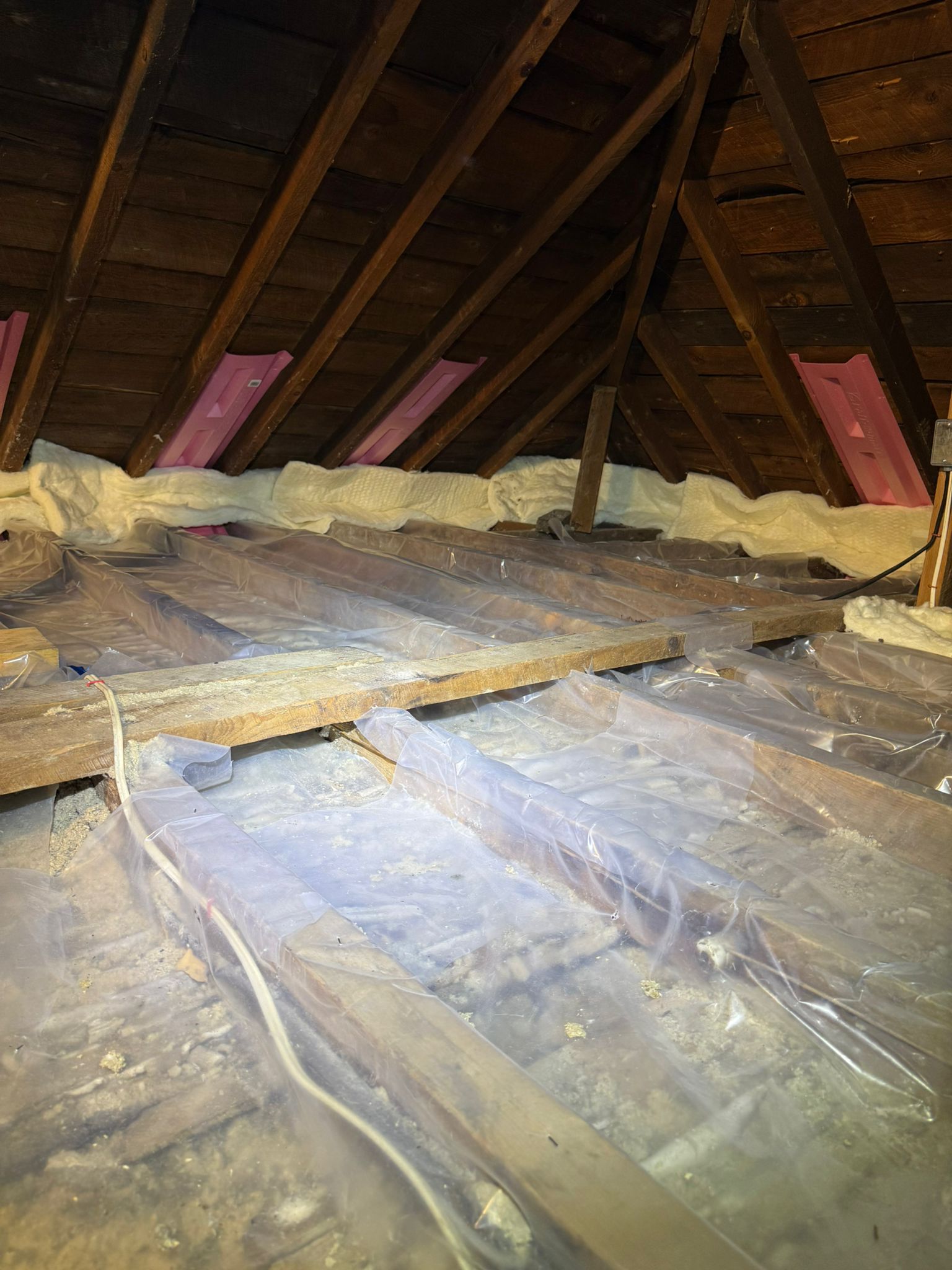
Little or no soffit venting. Many older Hamilton homes were built without it, or had it covered when aluminum soffit went on decades later. Insulating an unventilated attic without addressing intake traps moisture and can make things worse, not better. Confirming and clearing intake, then installing baffles, is part of a proper job. Baffle installation →
Uninsulated brick walls. Most pre-war Hamilton brick homes have little or no wall insulation. You can’t fix that from the attic, and you usually can’t open the walls without a gut reno. The retrofit route is drill and fill — small holes, insulation blown into the cavity, holes patched. Worth knowing before you commit to attic-only work. Drill and fill →
Balloon framing. Many older Hamilton houses were balloon-framed, meaning the wall cavities run uninterrupted from basement to attic. That creates hidden vertical air paths that carry heat straight up and out. Air sealing at the top of those cavities, in the attic, is part of doing the job properly — and it’s invisible if skipped.
If you own a post-1970 home (Stoney Creek, the Mountain, Ancaster, Waterdown)
Different house, different list. These attics are usually easier to work in — engineered trusses, real headroom, a proper hatch — but they have their own recurring shortfalls.
It was insulated to the minimum of its build year, and it’s settled since. The standard in 1985 was well below where an attic sits today, and loose fill loses depth over time. What’s up there now is less than what went in.
Baffles missing or crushed. Commonly skipped in production building, or dislodged by a later top-up that then buried the soffits.
The attic hatch was never insulated. Usually a bare panel, no weatherstrip. A hole in your ceiling.
The ceiling was never air sealed. Top plates, wiring holes, plumbing stacks, exhaust fans, and any pot lights added during a later renovation. Seal first, insulate second — otherwise the leaks get buried.
The room over the garage. Cold because its floor sits over an unheated garage, not under the attic. More attic insulation won’t touch it; the fix is closed-cell foam in the garage ceiling. Garage ceiling insulation →
The Hamilton problem both house types share: ice dams
This deserves its own section because Hamilton sees it more than most of the GTA.
What an ice dam is: heat escaping into the attic warms the roof deck, snow melts, the water runs down to the cold eaves and refreezes into a ridge of ice. Water then backs up behind that ridge, under the shingles, and into your ceilings and walls.
Why Hamilton in particular: the escarpment and proximity to the lake drive freeze-thaw cycling and lake-effect snow, which is exactly the pattern that builds ice dams. If you get ice along your eaves or icicles hanging off the gutters every winter, that’s the mechanism at work.
What actually causes it: not cold weather — heat and air leaking into the attic, plus inadequate ventilation. Which means the fix is the same building science as everything above:
- Air seal the ceiling so heat stops leaking up
- Insulate to full depth, right out to the eaves, so the roof deck stays cold and uniform
- Ventilate properly — clear soffit intake, baffles, a working exhaust path — so any heat that does get up there is carried away
Adding insulation without air sealing and ventilation can move the problem around rather than solve it. This is why “just blow more in” quotes often don’t fix the icicles.
What a proper job looks like
- Assess — measure existing depth, identify the material, check wiring, venting and penetrations
- Test or stop for vermiculite and knob-and-tube where present
- Remove only if contaminated
- Air seal the ceiling plane — including the tops of balloon-framed wall cavities in older homes
- Clear intake and install baffles
- Insulate and weatherstrip the hatch
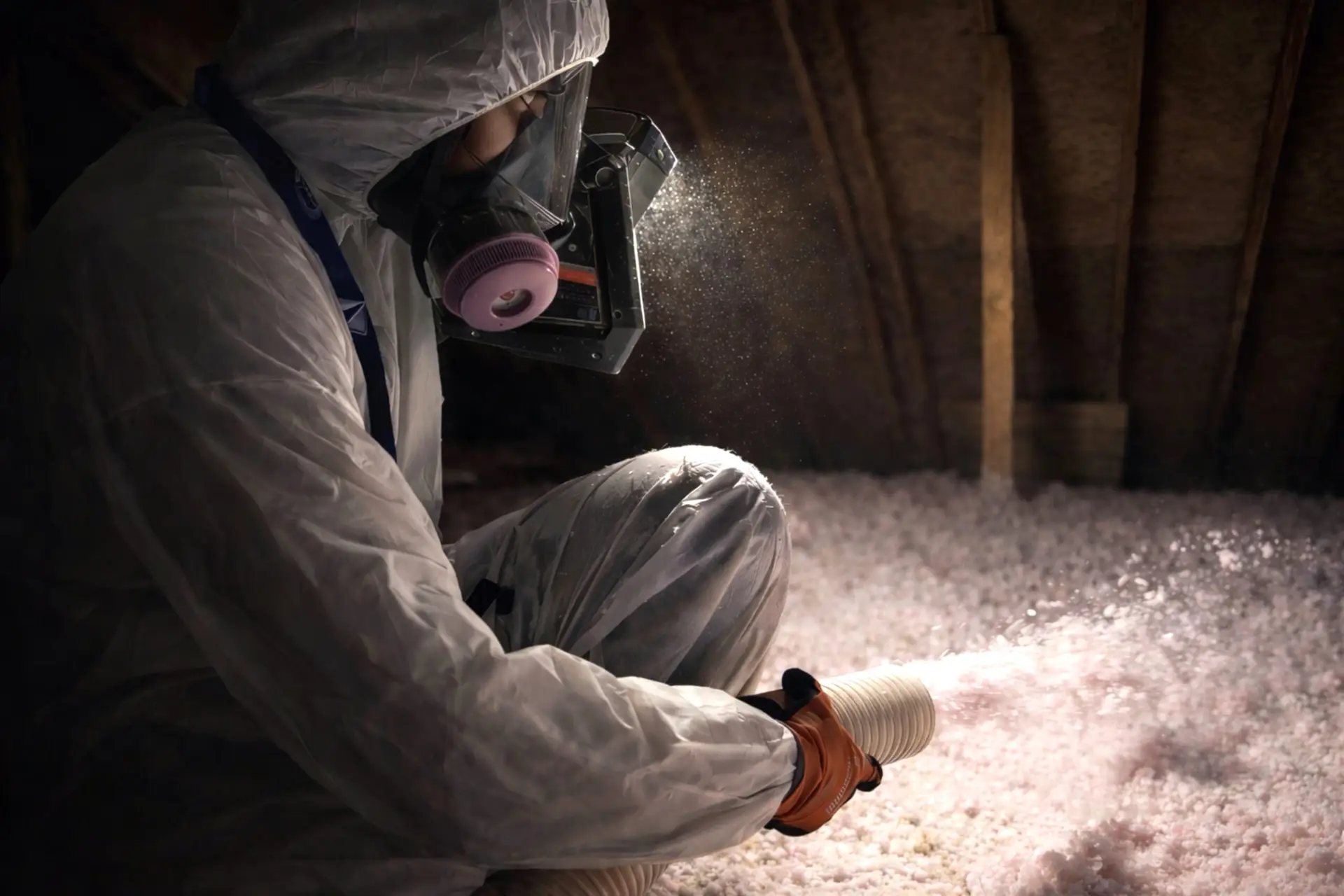
- Blow to depth to the eaves — R-50 minimum, R-60 target
- Mark depths so the result is verifiable
On material: cellulose gets more R-value into less depth and is denser, which suits the leaky, awkward attics of the older core. Fibreglass is lighter and often the cheaper route to the same number in a roomy newer truss attic. Both are rebate-eligible.
Cellulose blown-in → · Fibreglass blown-in →
Frequently asked questions
I have knob-and-tube. Can you insulate my attic? Not over active circuits. A licensed electrician has to assess it first. If it’s confirmed dead, the work can go ahead.
How do I know if I have vermiculite? Look for loose, pebble-sized greyish granules, quite different from fluffy fibreglass or shredded cellulose. If you see it, don’t disturb it — arrange testing.
Why do I get ice dams / icicles every winter? Heat and air leaking into the attic, usually with inadequate ventilation. The fix is air sealing, full-depth insulation to the eaves, and proper airflow — not just more insulation.
Do I need to remove the old insulation? Only if it’s contaminated by mould, water, rodents or smoke, or if it’s vermiculite needing testing. Clean, dry material can be topped up and the R-values add.
My house is brick with no wall insulation. Can that be fixed? Usually, via drill and fill — without opening the walls. It’s separate from attic work but often worth doing together.
Do I have to leave during the work? No.
How long does it take? A straightforward top-up is typically a single day. Removal, electrical work or ventilation fixes extend it — which is why the assessment comes first.
Get it assessed by someone who’ll go up there
Hamilton’s housing is too varied for a phone quote. Whether it’s knob-and-tube and vermiculite in the lower city or a settled truss attic on the Mountain, the only useful first step is someone measuring, checking the wiring and venting, and looking for what’s actually up there.
Pro Insulation Contracting has insulated Ontario homes for over 10 years. Free on-site assessment, written scope, fixed price before any work begins — and if we find something that needs an electrician or an abatement contractor first, we’ll tell you rather than work around it.
📞 (416) 315-0471 · Book a free attic assessment →